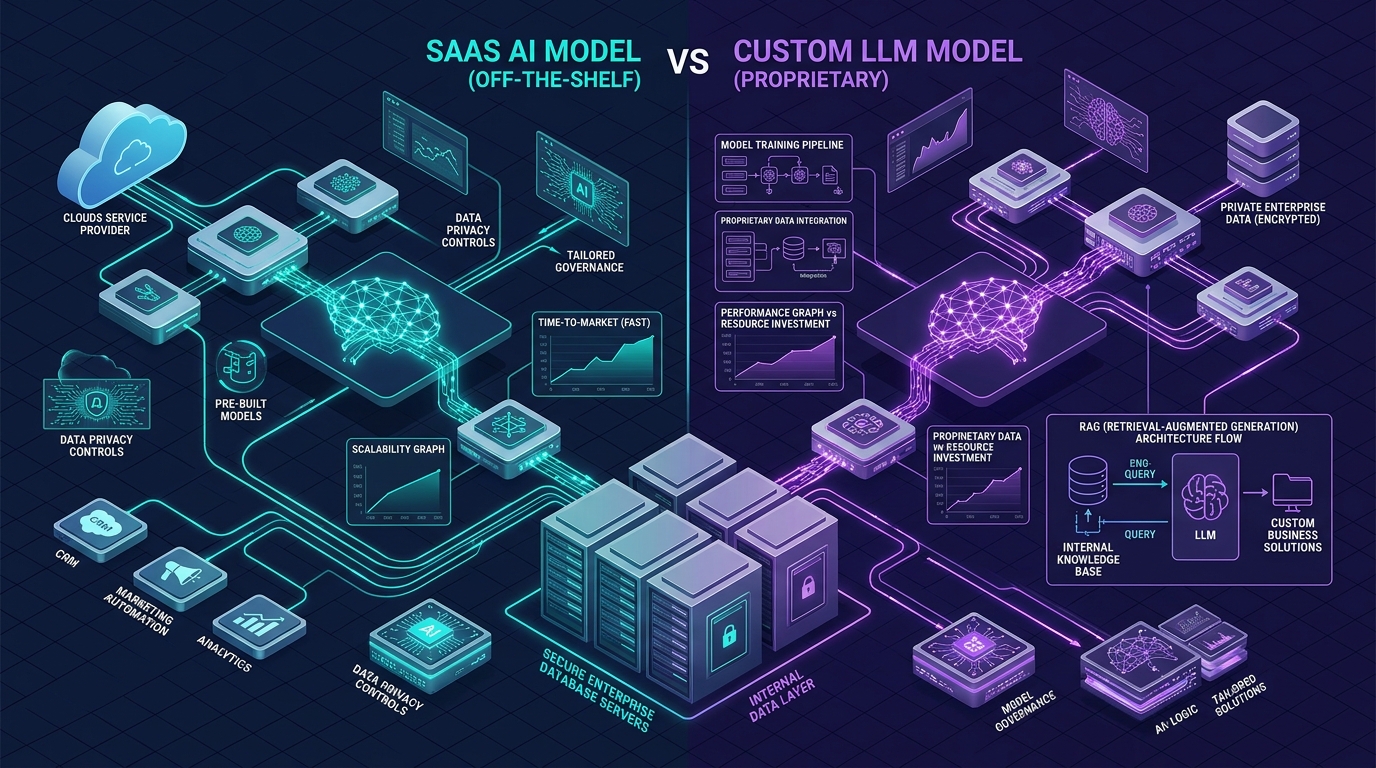
Artificial Intelligence has transitioned from an experimental novelty to a core operational driver for modern enterprises. As business leaders seek to integrate AI into their workflows, they face a pivotal strategic decision: Should you adopt a ready-made SaaS AI solution (like ChatGPT Enterprise or Claude) or build a Custom LLM solution using Retrieval-Augmented Generation (RAG)?
Both approaches have distinct advantages, but making the wrong choice can lead to data privacy risks, vendor lock-in, or runaway API costs. Here is a breakdown of the 5 critical factors every enterprise must evaluate.
1. Data Privacy, IP Security, and EU AI Act Compliance
For enterprise organizations handling sensitive customer records, proprietary source code, or financial data, privacy is non-negotiable.
- SaaS AI Solutions: Commercial APIs route your data through external cloud servers. While enterprise tiers promise no data training on your inputs, your sensitive data still crosses organizational boundaries.
- Custom LLM / Private AI: Hosting an open-source or fine-tuned model (e.g., Llama 3 or Mistral) within your private cloud environment ensures 100% data sovereignty and total alignment with the EU AI Act and GDPR.
2. Domain Precision and Eliminating Hallucinations
Generic SaaS AI models are trained on internet-scale data. While excellent at general communication, they often struggle with specialized company knowledge and can produce confident, incorrect answers ("hallucinations").
The RAG Advantage: By pairing a Custom LLM framework with Retrieval-Augmented Generation (RAG), the model accesses your company’s real-time internal databases, ERPs, and documentation. This delivers domain-specific answers grounded exclusively in your business data.
3. Total Cost of Ownership (TCO): Subscription vs. Infrastructure
Understanding the long-term cost trajectory is essential when scaling AI operations across hundreds or thousands of users. A thorough comparison requires looking beyond the initial setup fees to evaluate overall scaling expenses and vendor lock-in risks.
SaaS AI Solutions offer a low or zero initial setup cost, making them appealing for quick experimentation. However, as adoption grows, scaling costs escalate rapidly due to high monthly per-user licenses or token consumption fees. Furthermore, relying on third-party SaaS providers creates significant vendor dependency, exposing your enterprise to unpredictable price hikes and sudden API policy changes.
Custom LLM & Private RAG Architectures require an initial investment in custom software engineering and cloud infrastructure setup. However, they deliver highly predictable, flat-rate cloud infrastructure costs as usage scales across your organization. Most importantly, owning the codebase and AI pipeline completely eliminates third-party vendor lock-in and gives your business full control over its technological assets.
4. Custom Workflow Integration and Latency
Off-the-shelf SaaS applications offer limited integration options, relying on standard webhooks. A custom AI architecture allows software engineers to embed intelligent agents directly into your core business systems, such as custom web platforms, automated mobile apps, or internal CRM systems.
This seamless integration enables multi-step automated actions—such as processing invoices, generating technical reports, or managing customer support tickets—without human intervention.
The Verdict: Which Option Fits Your Business?
- Choose SaaS AI if: You need immediate, low-volume automation for general office productivity and do not process confidential intellectual property.
- Choose a Custom LLM / RAG System if: You require high data privacy, deep integration with internal systems, zero hallucination tolerance, and long-term cost control for high-volume enterprise operations.
Accelerate Your Enterprise AI Strategy
Building custom, secure, and scalable AI solutions requires experienced software engineering. At VAO.PL, we help companies design, integrate, and deploy tailor-made LLM architectures that drive real ROI.